by Dr. Jacqueline S. Allen | May 20, 2020 | Blog, Endodontics, Save Your Tooth Month
 While 2019 may have been the year of decluttering, thanks to author Marie Kondo, this year people are considering the value of conserving the things that matter the most to them. Savingfamilyscrapbooks is a no-brainer when it comes to things to hold on to, but what about saving one of the most important parts of our body – our teeth?
In 2019, the American Association of Endodontists (AAE) expanded their Root Canal Awareness Week, traditionally observed during May, into SaveYourToothMonth. The organization has amplified its message that endodontics – the dental specialty area concerned with treating and better supporting the function of dental pulp – plays an important role in helping clients retain use of their natural teeth for a lifetime.
Why Is Saving My Teeth Important?
Our teeth are crucial to our ability to eat, speak, and smile. When a tooth is extracted because it has been damaged by infection or trauma, other teeth can shift, leading to a host of dental problems.
A smile (or lack of one) is one of the first things others notice, so if you are missing even a few natural teeth, your self-confidence can plummet. Dental restorations such as bridges and dental implants can provide significant support to those who have lost a natural tooth, but the procedures to provide them are often costly and require repeated dental visits to complete.
How Can Endodontics Help Preserve My Natural Teeth?
Endodontic dental specialists have benefited from improvements in technology and technique in the last generation and have multiple ways to help save your natural teeth. Some of their most common services include:
- Root canal treatment
- Endodontic retreatment of failing root canals
- Apicoectomy, or root-end resection, which treats the bone around the tip of your tooth root
- Stabilizing and providing emergency care to teeth that have been knocked out or suffered other types of dentaltrauma
“The primary goal of endodontics is to save your natural teeth,” says Dr. Jacqueline S. Allen, founder of and current practitioner at the Phoenix Endodontic Group. “Our staff provides individualized guidance to each client on the best ways to help them keep their teeth and avoid extractions whenever possible. Our offices stand ready to help you deal safely with all your endodontic needs.”

by Dr. Jacqueline S. Allen | Mar 31, 2020 | Blog, Endodontics, Endodontist, Root Canal
A damaged or infected tooth needs to be assessed by a dental professional as soon as possible. Endodontists are dental professionals who specialize in saving natural teeth through root canal treatments and other procedures. However, even with today’s technology, the most skilled of endodontists cannot save every tooth. There are times when the best course of action is simply to have a failing tooth removed.
Situations In Which A Root Canal Is Better
-
The symptoms of a damaged tooth are recognized early. If you notice severe pain while chewing, a pimple on your gum, tender gums, lasting sensitivity to hot or cold foods, or certain other symptoms that indicate your tooth’s pulp is infected, schedule an appointment with your dentist or endodontist immediately. The sooner your tooth can be examined, the more likely it is your natural tooth can be saved.
-
Your tooth’s structure is still strong. Root canals remove the nerve pulp inside your tooth’s roots and replace them with a biocompatible material. A crown is placed over the treated tooth to provide it with additional support. This treatment can be effective long-term 95 percent of the time, but if your tooth’s structure has been eroded by decay or injury, it is much less likely to be successful.
-
Your tooth roots are relatively easy to clean. The success of a root canal hinges largely on how well your endodontist can remove infection from your tooth roots before sealing the canals. If you have long or unusually shaped root canals, this may be difficult.
When Extraction Is Better
Your dental professional may recommend a tooth extraction if any of the following are true:
-
The tooth is badly decayed
-
The tooth has suffered a severe fracture
-
The tooth isn’t supported well by the surrounding gum tissue due to periodontal disease
-
The tooth has received a root canal treatment or retreatment and is still failing
“Your endodontist can determine whether an extraction and tooth replacement or a root canal is the better option for your natural tooth,” says Dr. Allen, who practices with the Phoenix Endodontic Group. “Both treatments are effective in restoring your mouth’s function and appearance.”

by Dr. Jacqueline S. Allen | Oct 25, 2019 | Blog, Endodontics, General Information, Phoenix Endodontic Group
Dental patients everywhere have something in common. No one enjoys shots. Often, it takes more than one injection to numb an area. It’s almost worse than the procedure itself! And when the procedure is done, you’re left with numbness spread throughout your mouth. It’s an unpleasant process, to say the least.
Our office has resolved these problems with the use of The Wand™, a new dental technology that enables us to provide anesthesia with little or no discomfort. With The Wand ™, we have control over the flow and delivery of anesthesia, plus this unique dental technology pinpoints intraligamentary tissue to help us identify the precise location for administering anesthesia.
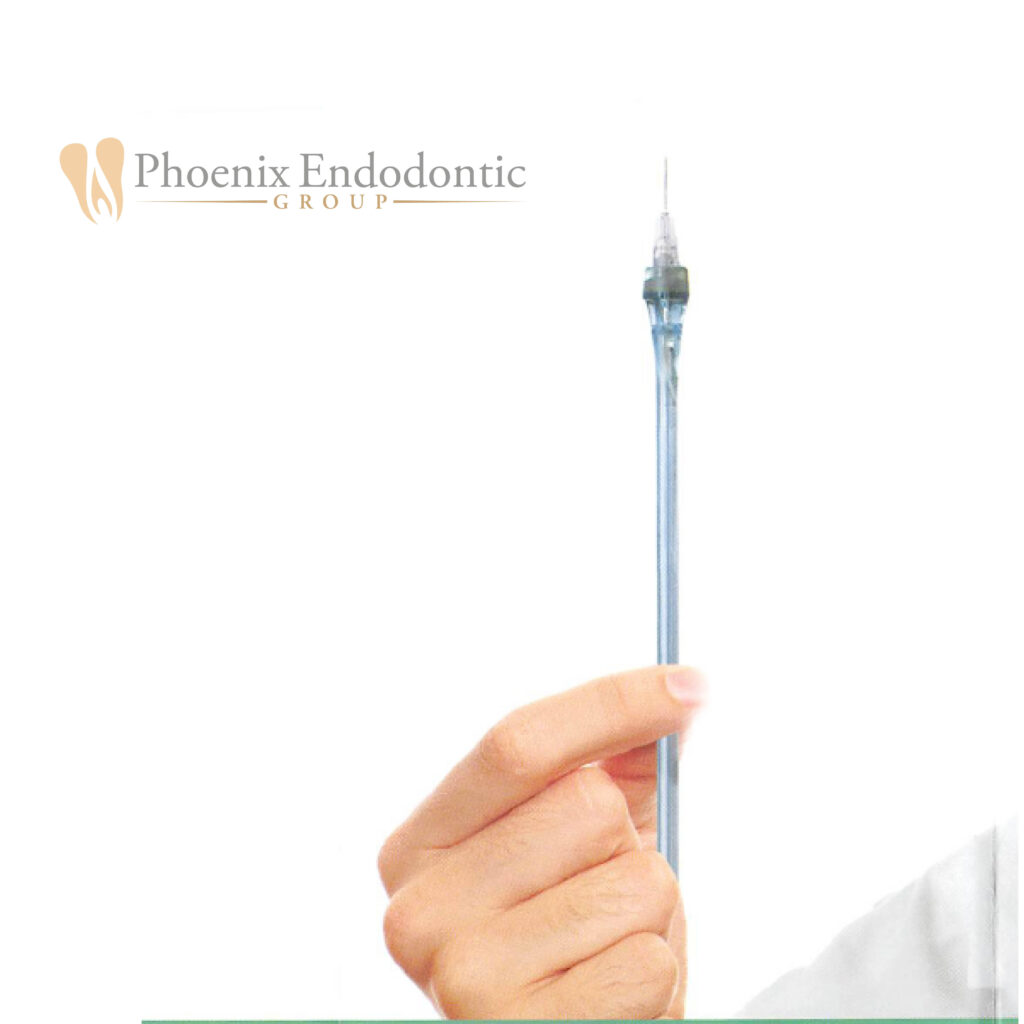
The Wand™ : A Powerful Dental Technology Breakthrough
- The Wand’s precise control allows for “single tooth anesthesia” (STA). You’re spared an entire numb mouth in favor of one numbed tooth. STA makes it easier to return to work comfortably, with no worries about talking, eating, or drinking. STA also means bilateral work on your mouth can be done on the same day.
- It doesn’t look scary. For patients with a fear of needles or of dentistry, this matters a lot. The Wand™ has a benign modern shape and is very non-threatening. The needle is a very small one in the tip of the device.
- It’s almost completely painless. This new dental technology’s precise control results in administration of the correct amount of anesthesia for the tissue, and many patients report The Wand™ makes the delivery of the anesthesia almost painless.
- It allows smile-line access. If your dentist is doing work that requires access to your smile line, this new dental technology makes it easy.
“Let us show you how our office can use new dental technology like The Wand™ to make your root canal or other procedure a more pain-free experience,” says Dr. Jacqueline S. Allen, endodontist at the Phoenix Endodontic Group. “The Wand™ makes it possible for us to give our patients a better experience with less pain and anxiety, and we’re pleased to offer it as a regular part of our practice.”
by Dr. Jacqueline S. Allen | Sep 20, 2019 | Blog, Endodontics, Endodontist, Root Canal
Millions of root canals are performed successfully each year. However, concern persists in some circles that instead of relieving a health problem – an infected or injured tooth – root canals cause illness. While there is no evidence to support this idea, rumors of the “dangers of root canal therapy” continue.
The American Association of Endodontists and other dental professionals are frequently asked by patients about the safety of root canals. Practitioners are happy to explain the root canal process and why root canals are the treatment of choice for preserving your natural teeth.
Root Canals And Health Problems: The Facts
- The primary research cited linking root canals to health problems is nearly a century old. Weston Price hypothesized in the early 1900s that bacteria trapped in a tooth treated by root canal caused diseases ranging from arthritis to heart disease. Needless to say, research methods and theories of disease causation were less advanced then; even studies conducted as early as the 1930s and 1940s indicated that there was no relationship between having a root canal and contracting a disease.
- Current research findings reinforce that root canals neither cause nor are correlated with other health challenges. In fact, a 2013 study in a publication by the American Medical Association noted that not only did root canals not cause cancer of any type, patients who had undergone multiple endodontic treatments had a 45 percent reduction in their cancer risk.
- Modern root canal treatment is safe and effective. With success rates of more than 90 percent, root canals have become reliable procedures for saving natural teeth. Digital imaging tools, advances in canal cleaning instruments, and the emergence of powerful disinfectants have all contributed to the ability of endodontists to save even seriously compromised natural teeth.
“There is a huge body of evidence demonstrating root canals are not associated with other health problems,” says Dr. Allen, who practices with the Phoenix Endodontic Group. “Your peace of mind is a top concern to us, of course, and we are happy to discuss why root canals are the best option for most people to save their natural teeth.”
by Dr. Jacqueline S. Allen | Aug 19, 2019 | Blog, Dental Implants, Dentistry, Endodontics, Endodontist
Risk management is a key part of our everyday lives. When it comes to managing dental health, patients want to be sure that a recommended procedure is safe as well as effective. In the past couple of decades, dental implants have become a popular option for replacing missing or failing teeth. Many people, though, question whether implants are the best choice for their oral health challenges.
While dental implants are not the right choice for every individual, they are in many cases a safe, effective restoration. Their record for safety extends beyond the immediate period after the implantation and has been well-documented for patients with a variety of oral health situations.
Factors That Make Dental Implants A Safe Choice
- Dental implants are unlikely to impact the rest of your mouth. When only one or a few teeth are failing, fixed bridges may be suggested as an alternative to an implant. However, unlike a bridge, dental implants do not require the adjacent natural teeth to be altered. Implants are impervious to tooth decay. They are also unlikely to cause gum disease if a patient follows a normal daily oral health care regimen.
- Dental implants have proven to be safe for most adults who can undergo an extraction or other oral surgical procedures. Two key factors in determining if dental implant surgery is appropriate are gum health and the amount of bone density in the jaw. If a candidate for dental implants has healthy gums, has adequate bone density, and lacks any serious underlying systemic health condition, the implant procedure is usually considered safe.
- Dental implants, like root canals, have a very high long-term success rate. Longitudinal studies have shown that dental implants have a success rate of around 98 percent. What this means is that if you take care of your dental implant properly, it could last for decades, if not the rest of your life.
“When evaluating a patient to receive a dental implant, our practice considers many factors. When the circumstances are right, implants are a safe choice to replace missing or failing teeth,” says Dr. Jacqueline S. Allen, an endodontist practicing at the Phoenix Endodontic Group.
by Dr. Jacqueline S. Allen | Jul 15, 2019 | Blog, Endodontics, Phoenix Endodontic Group, Root Canal
If you are referred to an endodontist for a root canal, you may be surprised to learn that, as critical as the procedure is to saving your natural tooth, you will also need a second procedure to ensure its long-term success. Most of the time, your endodontist will recommend placing a crown on the tooth with the root canal. To understand why, it is helpful to review what root canal treatments do and the after-care needed to support them.
Why Teeth Treated With Root Canals Need Crowns
- A root canal replaces your tooth’s nerve pulp with a biocompatible material. This substitution of gutta-percha or another biocompatible substance is what makes it possible to save your tooth, but it also makes the tooth more brittle. This means it can be more vulnerable to chipping or cracking.
- The infection or breakage that led to the need for a root canal may have permanently weakened the tooth. By the time a root canal is recommended, your tooth may have already sustained structural damage. A crown can cover your entire tooth above the root line and provide protection your natural tooth has lost.
- Previous dental work may have weakened your tooth. Dental fillings can fail and leave teeth prone to decay. Teeth on either side of a bridge may have been altered to hold the restoration in place. Other types of dental work can also reduce the strength of your teeth.
- Crowns can prevent coronal leakage. If the filling that seals in the biocompatible tooth root material develops a leak, infection can get in and ruin the root canal. Crowns are the best restoration to prevent this type of potential damage.
“Root canals regularly save natural teeth, and a root canal topped with a crown can allow that tooth to last as long as the rest of your teeth,” says Dr. Allen, an endodontist with the Phoenix Endodontic Group. “Our practice is happy to explain the importance of each step of the root canal process.”
