
by Dr. Jacqueline S. Allen | Oct 7, 2026 | Blog
Your natural teeth are designed to last a lifetime. While modern dentistry, including endodontic treatment, can save teeth that have been damaged or infected, the best outcome is always keeping your teeth healthy in the first place. The good news? Great oral health does not require complicated routines or expensive products. It comes down to a handful of consistent, everyday habits.
As endodontists, our team at Phoenix Endodontic Group sees firsthand what happens when small problems go unnoticed. Here are five simple steps you can take to protect your smile, prevent painful problems, and keep your natural teeth for years to come.
Step 1: Brush Correctly, Twice a Day
Brushing is the foundation of good oral health, but how you brush matters just as much as how often. The American Dental Association recommends brushing twice a day for two minutes each time using a fluoride toothpaste.
Tips for a more effective brushing routine:
- Use a soft-bristled brush. Hard bristles can wear down enamel and irritate your gums over time.
- Angle the brush toward the gumline. Hold your brush at about a 45-degree angle and use gentle, short strokes.
- Don’t forget every surface. Clean the outer, inner, and chewing surfaces of every tooth, plus your tongue.
- Replace your toothbrush regularly. Swap it out every three to four months, or sooner if the bristles are frayed.
- Brush gently. Scrubbing harder does not clean better and can contribute to gum recession and tooth sensitivity.
Step 2: Clean Between Your Teeth Every Day
Even the most thorough brushing cannot reach the tight spaces between your teeth and just below the gumline. These areas are where plaque and food particles tend to collect, and where cavities and gum disease often begin.
Cleaning between your teeth once a day helps remove that buildup before it hardens into tartar. Traditional floss works well, but it is not the only option. Interdental brushes, floss picks, and water flossers are all effective tools. The best choice is the one you will actually use consistently.
If your gums bleed a little when you first start flossing, don’t stop. Mild bleeding is often a sign of gum inflammation that improves with regular cleaning. If bleeding continues after a week or two, mention it to your dentist.
Step 3: Make Tooth-Friendly Food and Drink Choices
What you eat and drink plays a major role in the health of your teeth. Every time you consume sugar, the bacteria in your mouth produce acids that attack your enamel. Acidic foods and drinks can also soften and wear away enamel directly.
Smart habits for a healthier smile:
- Limit frequent snacking on sweets. How often you eat sugar matters more than how much. Constant sipping or snacking keeps your teeth under acid attack.
- Watch acidic drinks. Soda, energy drinks, sports drinks, and citrus juices can erode enamel over time.
- Drink plenty of water. Water helps rinse away food particles and supports healthy saliva flow, which is your mouth’s natural defense. In the Arizona heat, staying hydrated matters even more.
- Choose nutrient-rich foods. Dairy products, leafy greens, lean proteins, and crisp fruits and vegetables help support strong teeth and healthy gums.
Step 4: Protect Your Teeth From Damage
Not every dental problem starts with decay. Cracks, chips, and injuries are common reasons patients visit our office, and many of them can be prevented. A cracked tooth can allow bacteria to reach the inner pulp, leading to pain, infection, and the need for a root canal.
Simple ways to protect your teeth:
- Wear a mouthguard for sports. Contact sports and activities like biking or skateboarding put teeth at risk of injury.
- Ask about a night guard if you grind or clench. Teeth grinding places enormous pressure on your teeth and can lead to cracks over time.
- Avoid chewing ice, hard candy, and pens. These habits are a common cause of chipped and cracked teeth.
- Never use your teeth as tools. Opening packages, tearing tape, or cracking nuts with your teeth can cause sudden damage.
- Avoid tobacco products. Smoking and chewing tobacco increase the risk of gum disease, slow healing, and contribute to oral cancer.
Learn more about the signs and treatment of cracked teeth.
Step 5: Keep Up With Checkups and Listen to Your Teeth
Regular dental exams and professional cleanings allow your dentist to catch problems early, often before you notice any symptoms. Most people benefit from a visit every six months, though your dentist may recommend a different schedule based on your needs.
Between visits, pay attention to what your teeth are telling you. Many tooth problems that require endodontic care start with subtle warning signs. Contact your dentist or endodontist if you notice:
- Lingering sensitivity to hot or cold that lasts after the food or drink is gone
- Pain when chewing or biting down
- Swelling or tenderness in the gums near a tooth
- A small bump or pimple on the gums
- Darkening or discoloration of a single tooth
These symptoms can point to an infection or inflammation inside the tooth. Tooth problems rarely resolve on their own, and waiting often allows an infection to spread. Read more about what happens if you ignore a tooth infection.
The earlier a problem is addressed, the better the chance of saving your natural tooth. Modern root canal therapy is comfortable, efficient, and highly successful, and it allows you to keep your own tooth rather than replacing it.
Your Partner in Saving Natural Teeth
Great oral health is built one day at a time. By brushing well, cleaning between your teeth, making smart food choices, protecting your teeth from injury, and staying alert to warning signs, you give your smile the best possible chance to last a lifetime.
If you are experiencing tooth pain, sensitivity, or swelling, the team at Phoenix Endodontic Group is here to help. Dr. Allen and Dr. Wolcott provide advanced endodontic care with a focus on comfort and saving natural teeth. Call us at (602) 242-4745 or contact us online. Same-day emergency appointments are available.

by Dr. Jacqueline S. Allen | Sep 11, 2026 | Blog, Endodontics, Endodontist

Being referred to an endodontist can feel a little unfamiliar — especially if you’ve never seen one before. Unlike a general dentist, an endodontist is a specialist who focuses exclusively on the inner structures of the tooth: the pulp, the nerves, and the root canal system. It’s a narrow field, which means the training, technology, and approach can vary meaningfully from one practice to another.
Choosing the right endodontist isn’t just about convenience or proximity. It’s about finding a provider you can trust to save your tooth, manage your comfort, and give you a clear picture of what’s happening and why. The right questions — asked before your first appointment — can make all the difference.
Here’s what to ask, and what to listen for in the answers.
What Are Your Credentials and Specialized Training?
Endodontists complete two to three additional years of advanced training beyond dental school, focused exclusively on root canal procedures, endodontic surgery, dental trauma, and pain management. They are required to pass specialty board exams and maintain continuing education to stay current in the field.
When evaluating a provider, it’s worth asking:
- What professional organizations do you belong to, and how do you stay current in the field of endodontics?
- How many years have you been practicing endodontics?
- How many root canal procedures do you perform each year?
Volume matters in procedural specialties. An endodontist who performs hundreds of root canals annually has a depth of experience that a general dentist who performs them occasionally simply cannot match.
At Phoenix Endodontic Group, Dr. Jacqueline Allen and Dr. James Wolcott have collectively performed thousands of root canal procedures over more than 25 years of combined practice. You can learn more about their backgrounds on our Providers page.
What Technology Do You Use?
The tools an endodontist uses directly affect the accuracy of their diagnosis and the thoroughness of their treatment. Technology has advanced significantly in recent years, and not all practices have kept pace.
Ask about:
- Digital X-rays vs. 3D cone beam CT (CBCT) imaging. Standard X-rays provide a flat, two-dimensional image. 3D cone beam imaging allows the endodontist to see the full three-dimensional anatomy of the root system — identifying hidden canals, fractures, and bone changes that a flat X-ray would miss.
- Surgical microscopes. These are essential for endodontic microsurgery and retreatment. A microscope allows the endodontist to work with a level of precision that is simply not achievable with the naked eye or loupes alone.
- Advanced cleaning systems. Ask whether the practice offers the GentleWave Procedure or similar technology. These systems clean the root canal system more thoroughly than traditional hand files, reaching microscopic spaces and reducing the risk of reinfection.
At Phoenix Endodontic Group, we use 3D cone beam CT imaging, surgical microscopes, and the GentleWave Procedure to ensure every patient receives the most precise and thorough treatment available. Learn more on our GentleWave page.
What Procedures Do You Offer?
Not all endodontic practices offer the full spectrum of endodontic care. Some focus primarily on standard root canal therapy. Others are equipped to handle complex cases, surgical procedures, and retreatments.
It’s worth confirming that the practice you choose can address your needs now — and down the road if complications arise. Ask about:
- Root canal therapy — including single-visit treatment when appropriate
- Root canal retreatment — for teeth that have been previously treated but are still symptomatic
- Apicoectomy (root-end surgery) — for cases where conventional treatment has not fully resolved infection at the root tip
- Dental trauma treatment — for cracked, fractured, or knocked-out teeth
- IV sedation — for patients with significant dental anxiety or complex cases requiring additional comfort measures
Phoenix Endodontic Group offers the full range of endodontic services, including root canal therapy, retreatment, apicoectomy, and IV sedation. Visit our Services page for a complete overview.
How Do You Manage Patient Comfort and Anxiety?
Dental anxiety is common, and root canal procedures have an outsized — and largely undeserved — reputation for being painful. A good endodontist will have clear, thoughtful answers to questions about how they manage pain and anxiety throughout the process.
Ask specifically:
- What type of anesthesia do you use?
- Do you offer sedation options for anxious patients?
- What can I expect to feel during the procedure, and what is normal afterward?
The answers — and the tone in which they’re delivered — will tell you a great deal about how the practice treats patients. A provider who takes your comfort seriously will have clear, reassuring answers, not dismissive ones.
Phoenix Endodontic Group offers IV sedation for patients through licensed dental anesthesiologists, and our team is trained to ensure each patient is fully comfortable before any procedure begins. Learn more about our IV Sedation options.
Can You Explain My Diagnosis Clearly?
Before agreeing to any procedure, you should fully understand what’s happening with your tooth, why treatment is recommended, and what your options are. A trustworthy endodontist will take the time to walk you through your X-rays or 3D imaging, explain the findings in plain language, and answer your questions without rushing.
Red flags to watch for:
- Feeling pressured to decide immediately without time to ask questions
- Vague or overly technical explanations with no effort to make them accessible
- Reluctance to discuss alternatives or the option of seeking a second opinion
A provider who is confident in their diagnosis and treatment plan will have no problem explaining it clearly, and will welcome questions rather than avoid them.
What Is Your Availability for Emergencies?
Tooth infections and dental pain don’t follow a schedule. If you develop significant pain, swelling, or other acute symptoms, you want to know that your endodontist can see you quickly — not put you on a waiting list.
Ask whether the practice offers:
- Same-day or next-day emergency appointments
- After-hours contact options for urgent situations
- Clear guidance on what to do if symptoms escalate before your appointment
Phoenix Endodontic Group offers same-day emergency appointments for patients experiencing acute dental pain or swelling. If something doesn’t feel right, we want to hear from you promptly — not days later.
Is the Practice a Good Fit for You?
Beyond credentials and technology, consider practical factors: Is the location convenient? Is the office easy to reach and navigate? Is the front desk responsive and helpful when you call? Do you feel heard and respected from your first interaction?
These details matter more than they might seem. A procedure that is already anxiety-inducing becomes easier when the environment — and the people in it — put you at ease.
Why Patients Choose Phoenix Endodontic Group
Phoenix Endodontic Group has been serving the Phoenix Valley for over 25 years, with more than 75,000 patients treated by Dr. Allen and Dr. Wolcott. Our practice is built on a simple belief: every patient deserves to understand their diagnosis, feel comfortable during treatment, and leave with their natural tooth intact whenever possible.
We offer the full range of endodontic services, advanced technology including the GentleWave Procedure and 3D cone beam CT imaging, IV sedation for anxious patients, and same-day emergency appointments. We welcome patients who have been referred by their general dentist, as well as those seeking a second opinion.
Explore everything our practice offers at phoenixendodontist.com, or learn more about our providers and their approach before your first visit.
Ready to Schedule Your Appointment?
If you have questions before booking or would like to speak with our team, we’re happy to help. Call us at (602) 242-4745 or contact us online to schedule your consultation. Same-day emergency appointments are available.
by Dr. Jacqueline S. Allen | Aug 11, 2026 | Apicoectomy, Blog, Root Canal
Root canals have a success rate of around 95% — which means that for the vast majority of patients, a single procedure is all it takes to eliminate infection and save the tooth. But occasionally, a tooth that has already been treated continues to  cause problems. Infection persists at the tip of the root, symptoms return, or a hidden issue that couldn’t be addressed through the crown of the tooth is preventing full healing.
When that happens, an apicoectomy may be the best path forward. It’s a minor surgical procedure — and for many patients, it’s what stands between keeping a natural tooth and losing it entirely.
Here’s a clear explanation of what an apicoectomy is, how it works, and when your endodontist might recommend one.
What Is an Apicoectomy?
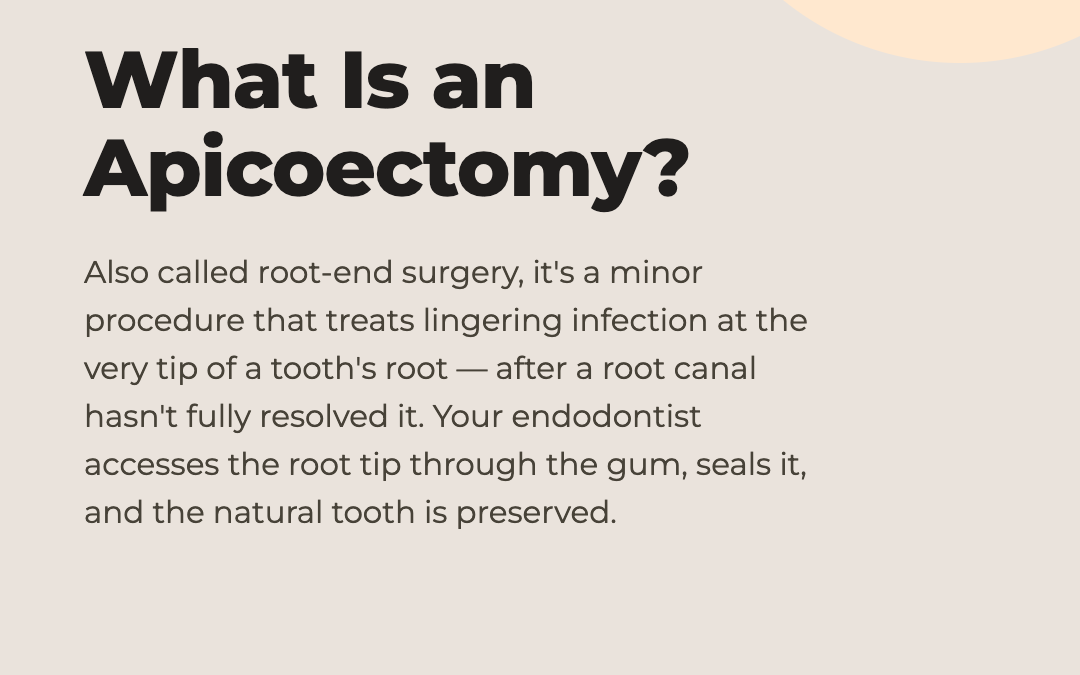
An apicoectomy — also called root-end surgery — is a minor surgical procedure that targets the very tip of a tooth’s root (called the apex) rather than approaching the tooth from the crown down, as a conventional root canal does.
During the procedure, your endodontist makes a small incision in the gum tissue near the affected tooth to access the root tip and the surrounding bone. The last few millimeters of the root — along with any infected tissue — are removed. The root tip is then cleaned, shaped, and sealed with a small filling to prevent bacteria from re-entering.
Over the following weeks and months, the jawbone naturally heals around the treated area, and the tooth is preserved.
You can learn more about the procedure directly on our Apicoectomy page.
How Is It Different from a Root Canal?
A conventional root canal approaches the tooth from the top — through the crown — to clean, disinfect, and seal the canals from the inside out. This works well for the vast majority of cases.
An apicoectomy approaches from the bottom up, through a small opening in the gum and bone near the root tip. Rather than working through the full length of the canals, the procedure targets the very end of the root where infection may be lingering or where the canals are too complex to fully clean through conventional means.
The two procedures address the same problem — infection or inflammation at the root — but from different directions and for different circumstances.
When Is an Apicoectomy Necessary?
An apicoectomy is not a first-line treatment. It is typically considered after a conventional root canal — and in some cases a retreatment — has not fully resolved the problem. Your endodontist may recommend an apicoectomy in the following situations:
Persistent infection after root canal therapy
Sometimes, even after a thorough root canal, infection remains at the tip of the root. This can happen because the root canal system is more complex than imaging initially revealed, or because a small pocket of infection was beyond the reach of conventional instruments.
Root canal retreatment is not feasible
In some cases, reopening and retreating the tooth isn’t possible or advisable — for example, if a post or crown makes access impractical, or if prior treatment has already been attempted more than once. An apicoectomy offers an alternative surgical route to address the problem.
Hidden canals or missed anatomy
Teeth — particularly molars — can have root canal systems that are far more intricate than they appear on a standard X-ray. An apicoectomy, combined with 3D cone beam CT imaging, allows the endodontist to identify and address anatomy that was not visible or accessible during the original treatment.
Calcium deposits blocking the canals
Over time, calcification can narrow or completely block the interior of a root canal, making it impossible to clean through conventional methods. An apicoectomy allows the endodontist to address the problem at the root tip without needing to navigate through the blockage.
A cracked root tip that cannot be repaired
When a crack extends into the lower portion of the root but not the entire length, removing the cracked section via apicoectomy may allow the remainder of the tooth to be preserved. If the crack extends too far, extraction may be the only option — and your endodontist will be straightforward with you about which applies.
Bone loss near the root tip
In some cases, infection-related bone loss has occurred around the root tip. An apicoectomy clears the infected tissue, allowing the bone to regenerate and stabilize the tooth over time.
What to Expect During the Procedure
Apicoectomies are performed under local anesthetic, so the area is fully numb before anything begins. Most patients are surprised by how manageable the experience is — the procedure is shorter and less involved than many people expect.
Here’s a general overview of what happens:
- A small incision is made in the gum tissue near the affected root to expose the bone and root tip
- A tiny opening is created in the bone to allow access to the root tip and any surrounding infected tissue
- The last few millimeters of the root are removed along with any infected tissue
- The root tip is cleaned with ultrasonic instruments and sealed with a biocompatible filling material
- The gum is sutured closed and healing begins
The entire procedure typically takes 30 to 90 minutes depending on the location and complexity of the tooth. Most patients return to normal activity within a day or two, with some mild soreness at the incision site that resolves within a week or so.
Is It Painful?
During the procedure, the area is fully numbed with local anesthetic and most patients feel little to no discomfort. Afterward, some tenderness and mild swelling near the incision site is normal and typically manageable with over-the-counter pain relievers. If antibiotics are needed due to active infection, they will be prescribed.
For patients with significant dental anxiety, our team also offers IV sedation to make the experience as comfortable as possible from start to finish.
Learn more about our IV Sedation options.
What Is the Success Rate?
Apicoectomies have a strong track record. Studies consistently show success rates of 85–97% depending on the tooth, the extent of infection, and the technique used. Modern microsurgical approaches — using surgical microscopes, ultrasonic instruments, and advanced sealing materials — have significantly improved outcomes compared to older methods.
At Phoenix Endodontic Group, we use surgical microscopes and 3D cone beam CT imaging to ensure the most precise, thorough treatment possible. In many cases, an apicoectomy is what allows a tooth to be preserved when all other options have been exhausted.
What Happens If an Apicoectomy Isn’t Performed?
If persistent infection at the root tip is left untreated, the consequences can escalate:
- The infection can spread to surrounding bone and soft tissue
- A dental abscess may develop or worsen
- The tooth may ultimately require extraction
- Bone loss in the area can complicate future tooth replacement
For patients who want to keep their natural tooth and have already exhausted conventional treatment options, an apicoectomy is often the last viable alternative to extraction. It is worth pursuing.
For more on how root canal retreatment and apicoectomy work together as part of a comprehensive treatment plan, visit our Root Canal Retreatment page.
Why Choose Phoenix Endodontic Group for an Apicoectomy?
Endodontic microsurgery requires a high level of specialized training and precision. Not all dental providers perform apicoectomies, and not all use the advanced tools that make the procedure as effective as it can be.
At Phoenix Endodontic Group, Dr. Jacqueline S. Allen and Dr. James F. Wolcott bring decades of combined experience in complex endodontic care, including apicoectomies. Our team uses surgical microscopes for enhanced visibility, 3D cone beam CT imaging for accurate diagnosis and surgical planning, and the latest biocompatible sealing materials for optimal outcomes.
Learn more about our providers and their approach at phoenixendodontist.com/providers.
Still Have Questions About Apicoectomy?
If you’ve been told your tooth hasn’t fully healed after a root canal — or if you’re experiencing recurring symptoms in a previously treated tooth — we’d encourage you to schedule a consultation. There may be more options than you realize.
Call Phoenix Endodontic Group at (602) 242-4745 or contact us online to schedule your appointment. Same-day emergency appointments are available.
by Dr. Jacqueline S. Allen | Jul 22, 2026 | Blog, Dental Emergency, Tooth Abscess
It starts small — a twinge when you bite down, a little sensitivity to hot or cold, maybe some tenderness along the gumline. It’s tempting to brush it off, especially if the pain comes and goes. But a tooth infection doesn’t resolve on its own. Left untreated, 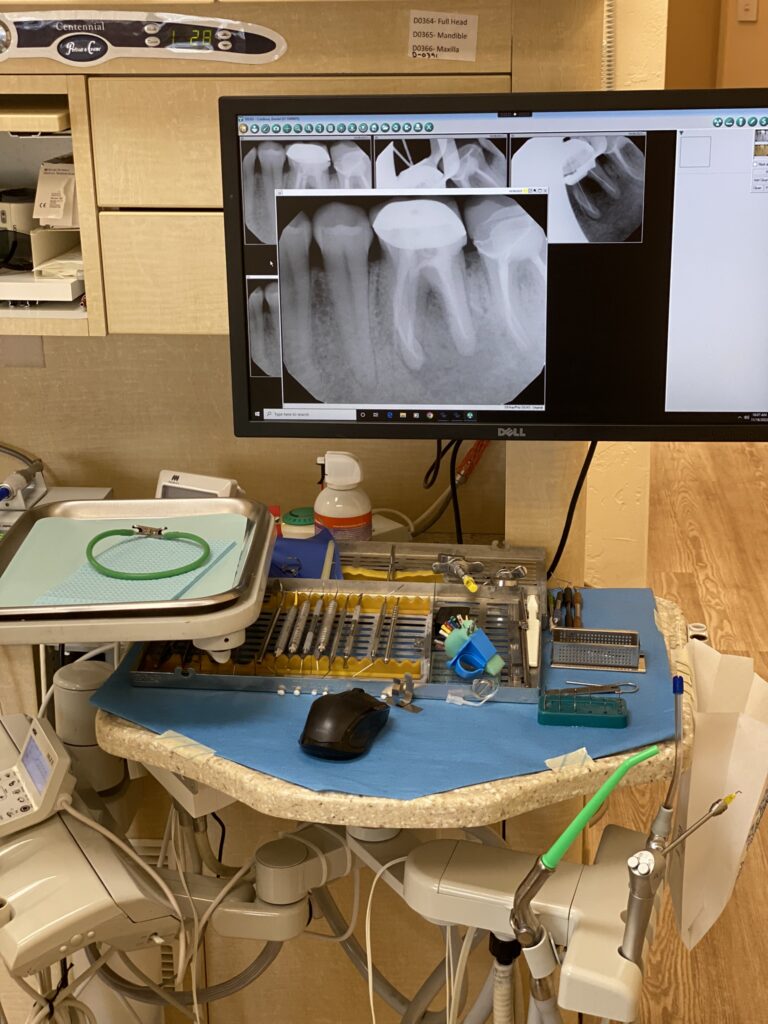 it can escalate from a minor annoyance into a serious health emergency. Here’s what actually happens when a tooth infection is ignored — and why acting early makes all the difference.
How a Tooth Infection Starts
Tooth infections usually begin with untreated decay, a crack, or trauma that allows bacteria to reach the pulp — the soft tissue at the center of your tooth containing nerves and blood vessels. Once bacteria invade the pulp, your body’s immune response kicks in, but the enclosed space of the tooth means pus and inflammation have nowhere to escape. This buildup is what eventually forms a dental abscess.
Stage 1: Localized Pain and Sensitivity
In the earliest stage, symptoms are often mild and easy to dismiss: occasional throbbing, sensitivity to temperature, or slight tenderness when chewing. Many people wait here, hoping the discomfort will pass. Unfortunately, this is exactly when treatment is simplest — and waiting only allows the infection to dig in deeper.
Stage 2: Abscess Formation
As the infection progresses, pus collects at the root tip, forming a visible or palpable abscess. Symptoms intensify — constant throbbing pain, swelling of the face or jaw, a bad taste in the mouth, and sometimes a low-grade fever. At this stage, the infection is actively damaging the surrounding bone and tissue, and home remedies or over-the-counter pain relievers only mask the problem.
Stage 3: Spreading Infection
If still untreated, the infection doesn’t stay put. It can spread to the jawbone, into the soft tissues of the face and neck, and in rare but serious cases, into the bloodstream or up toward the sinuses and brain. Swelling can begin to affect breathing or swallowing, which is a medical emergency requiring immediate attention — not a wait-and-see situation.
Why Prompt Treatment Matters
The earlier a tooth infection is treated, the more likely your natural tooth can be saved through root canal therapy — removing the infected pulp, disinfecting the canal, and sealing the tooth so it can keep functioning normally. Wait too long, and extraction may become the only option, which opens the door to a separate set of problems: shifting teeth, bone loss, and the cost and time of replacement options like implants or bridges.
Frequently Asked Questions
Can a tooth infection go away without treatment?
No. Antibiotics may temporarily reduce swelling or discomfort, but they don’t eliminate the source of the infection inside the tooth. Only endodontic treatment or extraction resolves it permanently.
How do I know if my tooth infection is an emergency?
Facial swelling, difficulty breathing or swallowing, a fever, or rapidly worsening pain are signs you need urgent care immediately — head to an emergency room if breathing or swallowing is affected.
Is it too late for a root canal if I’ve waited a long time?
Not necessarily. Many teeth can still be saved even after prolonged infection. The only way to know is a prompt evaluation — the longer you wait, the fewer options you may have.
Don’t Wait Out a Tooth Infection
If you suspect a tooth infection, don’t wait for it to get worse. Phoenix Endodontic Group offers same-day emergency appointments to diagnose and treat infections quickly, with the goal of saving your natural tooth whenever possible.
Call us today at (602) 242-4745 or visit phoenixendodontist.com to schedule your a

by Dr. Jacqueline S. Allen | Jun 4, 2026 | Blog, Root Canal Aftercare
You made it through your root canal — and now you’re wondering what you can actually eat. This is one of the most common questions patients ask before leaving the office, and it’s a good one. What you eat in the days following your procedure can make a real difference in how quickly you heal, how comfortable you feel, and whether your tooth stays protected while it recovers.
Here’s everything you need to know about eating after a root canal, from the first few hours through the days that follow.

First: Wait Until the Numbness Wears Off
Before you eat anything, give your mouth time to fully recover from the local anesthetic. Numbness from the injection can last anywhere from two to four hours after your procedure — and eating while numb is an easy way to accidentally bite your cheek, tongue, or lip without realizing it.
It also makes it harder to gauge the pressure and temperature of food, which can stress the treated tooth or surrounding tissue. The safest approach is to wait until full sensation has returned before eating your first post-procedure meal.
What to Eat the Day of Your Procedure
Once the numbness has resolved, stick to soft, cool, and easy-to-chew foods for the first 24 hours. The goal is to minimize pressure on the treated tooth and avoid anything that could irritate the area or disrupt the temporary restoration.
Good options for day one:
- Yogurt — smooth, cool, and easy to eat with no chewing required
- Applesauce — gentle and soft with no hard pieces
- Scrambled eggs — soft, protein-rich, and easy on the jaw
- Mashed potatoes — filling and completely soft; skip any crunchy toppings
- Smoothies and protein shakes — a great way to get nutrients without chewing; avoid using a straw (the suction can create pressure)
- Soup — lukewarm broth-based soups work well; avoid very hot temperatures
- Soft fish — like tilapia or cod, which flakes easily and requires minimal chewing
- Bananas — naturally soft and easy to eat
- Pudding or gelatin — light, cool, and effortless
Keep temperatures mild — not too hot and not too cold. The treated area may be more sensitive than usual, and temperature extremes can cause discomfort even when the nerve has been removed, due to the surrounding gum and bone tissue still recovering.
What to Eat in the Days Following Your Root Canal
By day two and three, most patients start feeling noticeably better. You can gradually introduce more variety into your diet, but continue favoring softer foods and chewing on the opposite side of your mouth from the treated tooth whenever possible.
Good choices for days 2–5:
- Pasta — cooked soft; avoid hard-edged shapes
- Rice and grains — gentle and easy to chew
- Soft-cooked vegetables — steamed or roasted until tender; avoid anything crunchy or raw
- Avocado — soft, nutrient-dense, and easy to eat
- Soft bread — without a hard crust
- Oatmeal — warm (not hot) and filling
- Hummus — a versatile soft option with good protein
- Soft cheeses — easy on the jaw and a good source of calcium
- Ground or shredded meat — such as slow-cooked chicken or beef that pulls apart easily
The key principle: if it requires you to bite down hard or chew with significant force, it’s worth waiting a bit longer before adding it back.
Foods and Drinks to Avoid After a Root Canal
Certain foods can interfere with healing, stress the treated tooth, or damage the temporary restoration that protects the tooth until your permanent crown is placed. Avoid the following until you’ve received your final restoration and your endodontist or dentist has cleared you:
Hard and crunchy foods:
- Ice — one of the worst offenders; biting ice can crack a tooth even under normal circumstances
- Nuts and seeds — hard and easily get lodged around the treated area
- Raw carrots, apples, and firm vegetables — require too much biting force
- Chips, crackers, and pretzels — the hard edges can press against sensitive tissue
- Hard candy or granola bars
Sticky and chewy foods:
- Gum — can pull at the temporary restoration
- Caramel and toffee — sticky candies can dislodge or damage temporary fillings
- Chewy bread or bagels — the pulling motion strains the tooth
- Dried fruit — surprisingly sticky and tough on recovering teeth
Temperature extremes and irritants:
- Very hot beverages — hot coffee, tea, or soup can cause discomfort and inflammation
- Very cold foods — ice cream, frozen drinks, and very cold water can trigger sensitivity
- Alcohol — can interfere with healing and interact with any medications prescribed
- Acidic foods and drinks — citrus juice, soda, and vinegar-based foods can irritate the treated area
A Note About the Temporary Restoration
At the end of your root canal, the tooth is sealed with a temporary filling to protect it until your general dentist can place a permanent crown. This temporary restoration is functional, but it is not as strong or durable as the final crown.
Eating hard, sticky, or crunchy foods before your permanent crown is placed puts the temporary restoration at risk of cracking, loosening, or coming out entirely — which can expose the tooth to bacteria and reinfection. Following dietary precautions until your final restoration is in place is one of the most important things you can do to protect your treatment investment.
For more on what to expect during recovery, visit our Root Canal Therapy page.
When Can You Return to Eating Normally?
Most patients are able to return to their regular diet within a few days of their procedure, as long as they continue to favor the opposite side of the mouth until the permanent crown is placed. Once the crown is cemented and fully set — which your dentist will confirm — you can eat normally without restriction.
Every patient’s recovery is a little different. If you’re experiencing significant pain, swelling, or sensitivity that is getting worse rather than better after the first couple of days, that’s worth a call to our office. Mild soreness is expected; escalating discomfort is not.
General Recovery Tips Beyond Diet
In addition to watching what you eat, a few other habits support a smooth recovery:
- Take any prescribed medications as directed. If anti-inflammatory or antibiotic medications were prescribed, complete the full course.
- Avoid smoking. Smoking slows healing and increases infection risk.
- Rinse gently. A warm saltwater rinse can help keep the area clean; avoid vigorous swishing in the first 24 hours.
- Sleep with your head slightly elevated. This can help reduce swelling overnight.
- Don’t skip your crown appointment. The temporary restoration is not meant to be permanent. Delaying the crown places the tooth at risk.
Have Questions About Your Recovery?
The team at Phoenix Endodontic Group is always happy to answer post-procedure questions. Dr. Allen and Dr. Wolcott and our entire care team are here to make sure your recovery goes smoothly. If something doesn’t feel right, don’t wait — give us a call. Reach us at (602) 242-4745 or contact us online. Same-day emergency appointments are available.

by Dr. Jacqueline S. Allen | May 6, 2026 | Blog, Pain, Root Canal, Tooth Abscess
It starts with a twinge. Maybe a brief flash of sensitivity when you drink something cold, or a dull ache that comes and goes. You take some ibuprofen, it calms down, and you move on with your day — hoping it was nothing.
Sound familiar? You’re not alone. Waiting out tooth pain is one of the most common things people do. But is it ever actually safe? And how do you know when the tooth is healing on its own versus when it’s quietly getting worse?
Here’s an honest look at what your tooth can — and can’t — recover from on its own.
The Short Answer: It Depends on What’s Wrong
Not all tooth pain is created equal. Some discomfort is temporary and harmless. Other pain is a signal that something serious is happening inside the tooth — and that’s where waiting becomes risky.
The key is understanding the source of the pain. Here are the most common scenarios:
When Tooth Discomfort Can Resolve on Its Own
There are a few situations where mild discomfort may settle down without treatment:
- After a recent dental procedure. It’s completely normal to feel sensitivity or soreness for a few days after a filling, cleaning, or crown placement. This typically resolves on its own as the tooth settles.
- Minor enamel sensitivity. If you’ve been using whitening products, eating a lot of acidic foods, or brushing too hard, you may experience temporary sensitivity. Cutting back on the trigger often helps.
- A very small, superficial crack. Tiny surface cracks (called craze lines) in the enamel don’t always require treatment and may not cause pain at all.
In these cases, keeping an eye on things makes sense. But “keeping an eye on it” means monitoring closely — not indefinitely ignoring it.
When Waiting Makes Things Significantly Worse
Here’s where things get important. If the pain involves the inner part of the tooth — the pulp, which houses the nerves and blood vessels — it will not get better without treatment. In fact, it almost always gets worse.
Signs the pain is coming from inside the tooth include:
- Throbbing or intense pain that lingers for more than a few days
- Sensitivity to hot or cold that doesn’t go away within 30 seconds
- Pain that worsens when you bite down
- A tooth that looks darker than the ones around it
- Swelling in the gum near the tooth, or a small pimple-like bump
- Pain that wakes you up at night
These are all signs of pulpitis — inflammation or infection of the tooth’s inner pulp. And here’s the thing about pulpitis: in its early stages, it may be reversible. Let it go long enough, and it becomes irreversible. The nerve dies, infection sets in, and what could have been a straightforward root canal may become an abscess requiring more complex treatment — or worse, tooth loss.
The “It Stopped Hurting” Trap
This is one of the most common reasons people delay care — and one of the most misleading signals a tooth can give you.
When a tooth that has been hurting suddenly goes quiet, it can feel like good news. But in many cases, it means the nerve has died. The infection is still there. The bacteria are still spreading. There’s just no nerve left to send a pain signal.
A tooth that has stopped hurting after weeks of pain should be evaluated by an endodontist — not celebrated. Painless doesn’t mean problem-free.
What Happens When an Infection Is Left Untreated
Dental infections are not self-contained. Without treatment, they can:
- Spread to the jawbone, causing bone loss
- Create a dental abscess that can rupture and spread to surrounding tissue
- In rare but serious cases, spread to the neck, airway, or bloodstream — a life-threatening complication
- Affect neighboring teeth, leading to more extractions
The longer an infection is left alone, the more complex — and costly — the treatment becomes. A root canal performed early is far simpler than managing a spread infection or replacing a lost tooth with an implant.
So What Should You Actually Do?
Here’s a simple rule of thumb: if tooth pain or sensitivity has lasted more than a few days, or comes with any of the warning signs listed above, it’s time to get it checked out. You don’t have to be in agony to call an endodontist. Earlier is always better.
At Phoenix Endodontic Group, we use advanced diagnostics — including 3D cone beam CT imaging and surgical microscopes — to find out exactly what’s going on inside your tooth. Many issues that feel minor from the outside are more progressed than they appear, and catching them early gives us the best chance of saving your natural tooth. Learn more about our approach on our Root Canal Therapy page.
The Bottom Line
Can a tooth heal itself? Sometimes — but only in a narrow set of circumstances, and never when the inner pulp is involved. The longer you wait on pain that doesn’t resolve, the fewer options you have.
Tooth pain is your body’s way of asking for help. Don’t wait until it stops asking.
Not Sure If Your Tooth Pain Needs Attention?
The team at Phoenix Endodontic Group is here to help you find answers. Dr. Jacqueline S. Allen and Dr. James F. Wolcott specialize in diagnosing and treating exactly these kinds of situations — quickly, comfortably, and with your long-term oral health in mind. We also offer IV sedation for anxious patients and same-day emergency appointments when you can’t wait. Call us at (602) 242-4745 or contact us online to schedule your appointment.
