
by Dr. Jacqueline S. Allen | May 12, 2014 | Blog, Endodontics, Root Canal
If you’re about to undergo a root canal, you probably have plenty of questions running through your mind. Dr. Jacqueline S. Allen of Phoenix Endodontic Group has performed this procedure countless times and offers this advice to prepare for yours.
 Getting ready for a root canal is mostly about following normal routines for mouth care beforehand. Continue to brush, floss, and rinse to keep your teeth and gums their healthiest before the root canal. The rest of your preparedness tasks are to make sure you have arrangements made for the day of the procedure and your after-care.
“Fortunately, most root canals are routine and require no special supplies or medical equipment to use after a procedure is completed,” Dr. Allen says. You’ll want to have on hand whichever pain reliever your medical doctor normally recommends. After a root canal is completed, most patients feel no discomfort at all and some may take a few days to feel before they heal completely, Dr. Allen adds.
“It would be a good idea to schedule your appointment at a time of day that allows you to go home after work, or visit the endodontist prior to work. Most offices are flexible regarding appointment times as long as it is not an emergency,” says Dr. Allen.
Once you’ve been scheduled, think about your post-procedure transportation. Most patients are able to drive themselves home, however “some people are sensitive and apprehensive about dental work, for those patients it is best that they arrange for a driver to take them home after treatment,” Dr. Allen cautions.
“Following the post-op instructions given to you by your endondontist after your root canal is the best way to ensure that you will enjoy a successful outcome. Those instructions can be to take ibuprofen/Tylenol for basic discomfort, take an antibiotic until it is finished (if one is prescribed) and do not chew or eat anything sticky or hard until you have had the permanent crown placed by your general dentist,” states Dr. Allen.
Call today to schedule your root canal with Dr. Allen and Phoenix Endodontic Group for the best result!
by Dr. Jacqueline S. Allen | May 5, 2014 | Blog, Endodontics, Root Canal
 Most people do have to face the fact that at some point in their life, they will have a tooth that “goes bad”, starts to cause pain and will need to have treatment to make it better. More often than not, a root canal can be performed and gives the patient many years of enjoyment free of pain and discomfort.
Even though a root canal is a great option for infected or abscessed teeth there may come a point where the patient considers a dental implant as a treatment option. The use of dental implants as a valid option has exploded in the last 10 years. Initially it was touted that extracting a tooth and placing an implant was a “permanent solution.” Studies have shown that implants can and do fail and are far from a permanent solution to tooth pain.
A common debate is “root canal vs. dental implant”, which is best for the patient?
As with many dental questions, there is no one right answer to this question, it depends upon many factors, patient’s age, overall health, opposing tooth and cost. Root canal cost v. implant cost is what we will probe in this article. In general terms, a single tooth implant will cost significantly more than a root canal. Let’s use a molar tooth in this example.
The root canal cost breaks down as follows: Exam, x-ray, root canal, buildup, crown. For a tooth to be fully restored after a root canal, it can take as few as two weeks.
The dental implant cost breaks down as follows: Exam, x-ray, extraction, bone graft, implant surgery, healing abutment and crown. Some dental implants can be placed immediately after extraction, however most of the time the extraction site has to heal for up to six months and the patient uses a stay plate or flipper to fill in the hole. A dental implant is a surgical procedure and the healing time for each patient can vary.
Here are the costs side by side, using the Usual and Customary Fees in the Phoenix, AZ area for endodontists and periodontists for a molar tooth:
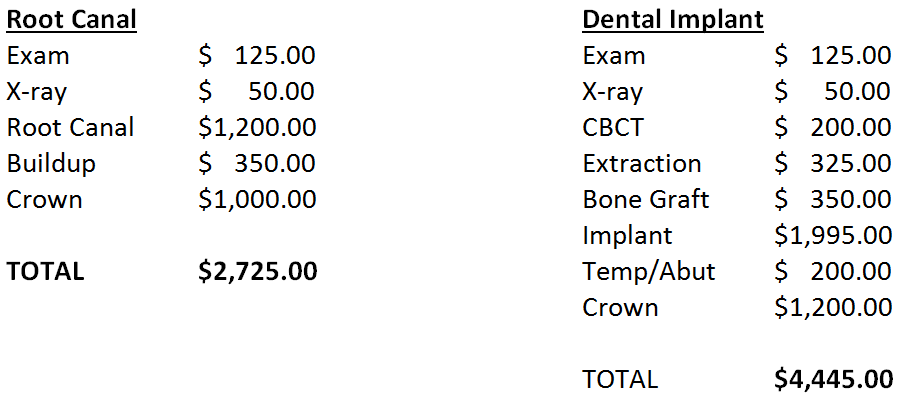
There are a lot of variables regarding both procedures, and the example above shows what the costs could be if you needed all of the services listed. The costs shown are representative of the root canal cost and dental implant cost and services in our market. As mentioned above, neither dental implants or root canal treatment will last forever. Before making a treatment choice, a patient should weigh all of the factors involved, speak with their general dentist and endodontist in order to make the most informed decision based on the individual.

by Dr. Jacqueline S. Allen | Apr 28, 2014 | Blog, Endodontics, Endodontist, Featured, General Information
 You probably already know that a twice-yearly dentist visit is a must for a healthy mouth. Why should you consider adding a Phoenix endodontist to your dental care program?
“The most common reason a patient needs to see an endodontist is that the patient is in pain or has an abscessed tooth. When a tooth becomes “necrotic” that means that the nerves and tissue inside the tooth are dying. Some people have pain, others do not. When the nerve has died and the patient does not feel it, the tooth may become more susceptible to fracture if left untreated,” says Dr. Jacqueline S. Allen, D.D.S., M.S. of Phoenix Endodontic Group.
An endodontist has advanced tools and equipment to diagnose and treat complex dental cases, plus specialized training. Fractured or chipped teeth, tooth decay, tooth pain, and trauma to the teeth are all examples of issues for which a Phoenix endodontist should be involved. “We treat many patients with complicated cases, and spend as much time and have as many visits as it takes to resolve a patient’s endodontic issue,” Dr. Allen adds.
Not all endodontists are the same, even if they provide the same menu of services. Dr. Allen states that “Phoenix Endodontic Group is a small family business. We strive to treat all patients the way we wish to be treated by our healthcare professionals. Attention to detail and prompt efficient service to patients has led us to develop many lasting relationships with our referring doctors.”
If you are trying to find the RIGHT endodontist, an important detail is the practice’s business approach. Those under insurance contracts may be limited in the services they provide and be encouraged to spend as little time as possible with each patient. “At Phoenix Endodontics, we take a limited amount of insurance contracts, because we feel that in endodontics patient treatment and care can be compromised if insurance companies are dictating what an endodontist can be reimbursed for a procedure,” remarks Dr. Allen.
“Personal attention and top quality care is what a patient will always get from Phoenix Endodontic Group,” Dr. Allen promises. Contact us today to schedule your appointment!
by Dr. Jacqueline S. Allen | Apr 21, 2014 | Blog, Dentistry, Endodontics
 Just about everyone knows how important it is to go to the dentist, but understanding what an endodontist can do for you may not be common knowledge. What is the difference between the services provided by an endodontist versus a regular dentist? Dr. Jacqueline S. Allen of Phoenix Endodontic Group is happy to describe the differences.
To help you understand the basics, endodontics is the study of the pulp inside your teeth, where connective tissues, nerves, arteries and veins live. Usually this pulp is protected by your enamel but can become compromised by cracks or cavities, leading to decay. This is where an endodontist saves the day! “The basic dental degrees are DMD (Doctor of Medical Dentistry) and DDS (Doctor of Dental Surgery). The difference is determined by the curriculum at the Dental School where the dentist attended. To become an Endodontist (Specialist), a dentist needs to attend a two year specialty program for an Endodontic Certificate or a three year program for a Masters Degree in Endodontics. Endodontists that only have DDS or DMD after their name have a certificate, Endodontists that have MS or MSD after their name have a Masters Degree in Endodontics.” says Dr. Allen, whose credentials are D.D.S., M.S.
While a general dentist may be able to perform procedures such as a root canal, he or she may only do a few of these per week and on simpler tooth structures. “Molar teeth and any retreatments are best performed by Endodontists. Molar teeth can have unique anatomy which makes finding all of the canals tricky, especially if the dentist does not use surgical microscopes when performing their procedures,” says Dr. Allen. “Surgical microscopes, Apex locaters, Cone Beam Computerized Tomography (CBCT) are all tools employed by endodontists to make the root canal experience as worry-free as possible for the patient.”
Generally, everyone needs to see a dentist twice a year for cleanings and exams. When your dentist identifies an issue more complex than he or she has the equipment or training to complete, you will be referred to an endodontist. For any question regarding the comfort or health of your teeth, call Phoenix Endodontic Group today!

by Dr. Jacqueline S. Allen | Apr 14, 2014 | Blog, Business, Dentistry, Endodontics
The premier dental practice instated thin clients to create a secure VDI environment protecting patient files at an affordable cost for their small healthcare service. In the healthcare industry protecting patient data is the key and setting up a secure VDI environment with thin clients was the best, yet affordable solution.
 Customer Overview
The Phoenix Endodontics Group is a premier endodontic specialty dental practice started in 2001. It is a relatively small practice consisting of three endodontists and is located in Phoenix and the Paradise Valley areas in Arizona. The practice has approximately 15 employees.
Challenge:
The Phoenix Endodontic Group had a mixed environment of Dell thin clients and traditional desktops. The devices connected to Citrix VDI environment with Windows 7 operating capabilities. The practice found that their current Dell thin clients were not properly redirecting USB image sensors to the patients’ dental electronic medical records and needed a solution.
Additionally, the Phoenix Endodontic Group found inconsistencies and technical problems similar to the issues they were facing with their Dell thin client devices with their traditional desktop units located in their front desk and administrative areas. These errors often occurred with USB based devices, scanners, and cameras.
Solution:
Facing the challenges above, the Phoenix Endodontic Group contacted a Devon IT integration partner in the Phoenix area, Phoenix PC Networking, who specializes in IT solutions for small and medium size companies.
Through Phoenix PC Networking, they purchased 10 Acer Veriton N2010G units running with DeTOS a Linux based thin client OS. They also re-imaged four of their Dell PC’s using Devon IT’s VDI Blaster software. The purchase of the 10 thin clients was used to solve the USB redirect challenge, and to allow the practice’s USB image sensors to communicate wirelessly with electronic patient medical records. This communication enabled the staff to pull patient images, send snapshots of images in real time, and maintain the records.
The purchase of Devon IT’s VDI Blaster software was then used to re-image four Dell PC’s located in the front desk area and in other administrative locations. This would allow for more efficient and reliable use of the daily USB devices used by the staff, increase over all security when dealing with confidential patient records, and create a user friendly environment for all current and future incoming staff.
Results and Benefits
Initial Results.
The 10 new Acer Veriton thin clients and re-imaged Dell PCs with VDI Blaster proved to be a perfect and cost effective solution for this small-sized medical-service provider. The Acer Veriton N 2010G with DeTOS eliminated the issue of USB redirect of patient information to their respective electronic medical records. The practitioners and other dental staff were able to successfully and wirelessly transmit patient information securely from medical devices to the patients’ electronic medical records.
Additionally, the Phoenix Endodontic Group found that the original inconsistencies and technical problems with the four Dell desktop units were also eliminated thanks to re-imaging with Devon IT’s VDI Blaster. The front desk and other administrative staff were able to use all USB devices with ease and securely handle sensitive patient documents with no additional training required.
The staff at Phoenix Endodontics benefited greatly from the simple VDI environment of the Acer thin clients that mirrors traditional PCs, which resulted in 0 time-lost due to staff training on the new devices.
Conclusion
The Phoenix Endodontic Group offered a perfect opportunity to highlight the benefits of alternative desktop computing for a small medical service provider in the healthcare industry.
“The healthcare industry can be a tedious place for technology with all of the privacy regulations and continued demand for increase security of patient documents,” said James T. Snodgrass, Phoenix PC Networking’s assigned integrator for the Phoenix Endodontic Group transition. “The Acer Veriton N2010G units and VDI Blaster repurposed PC’s gave our client the required technology updates that were sought when Phoenix Endodontics contacted us, and it also provided them with the increased security that is demanded in this industry.”
