
by Dr. Jacqueline S. Allen | Feb 20, 2020 | Blog, Dental Implants, Phoenix Endodontic Group
Sometimes to get the right answer about your oral health, you have to ask the right question. If your question is “Is it possible to perform a dental implant in one day?” the answer is a definite yes. However, if your question is “Can I have a dental implant done in one day?” the answer is a solid maybe.
Over the past few decades, dental implants – whether to replace one tooth or an entire arch of teeth – have become a popular alternative to dentures. However, a dental implant is a complex procedure. Your dentist or oral surgeon will need to conduct a thorough examination of the state of your teeth and gums to determine if a single-day implant would be successful for you in the long term.

Factors That Determine Whether A Single-Day Implant Process Is Possible
- How many natural teeth need to be replaced. The greater the number of failing or missing natural teeth, the more pre-treatment assessment planning it will take to ensure the success of a single-day implant. If failing teeth are to be extracted at the same time as the dental implants are placed, this will also impact how your dental team approaches the procedure.
- The bone density of your jaw. Dental implants are secured by metal posts or fixtures that are placed in your jawbone. If you need numerous implant posts to support the crowns that will replace your lost teeth above the gumline, you may need to undergo bone grafts to increase bone density.
- Your gums and remaining teeth must be healthy. For a single-day dental implant procedure to succeed, your mouth should be free of gum disease and infected or damaged teeth.
- You can commit to a significant healing period after your single-day implant is delivered. After a dental implant procedure, you must carefully watch what you consume for six to eight weeks, while your implants integrate into your jaw.
“Advancements in both technology and dental implant techniques allow us to place dental implants faster and with far less discomfort than ever before,” says Dr. Jacqueline S. Allen, an endodontist in practice at the Phoenix Endodontic Group. “Our staff can evaluate the condition of your teeth and gums and provide an accurate estimate of how long your dental implant may take to complete.”

by Dr. Jacqueline S. Allen | Feb 10, 2020 | Blog, Endodontist, Phoenix Endodontic Group, Root Canal
Dr. Jacqueline Allen is qualified to utilize the minimally invasive Waterlase™ to treat dental conditions with less discomfort to the patient and in some cases use less to no anesthetic. Dr. Allen completed the advanced endodontics continuing education with Dr. William Chen, at the Chen Laser Institute. The course provided in depth training for laser-assisted endodontics to help meet many of the toughest clinical challenges and techniques on single and multiple root canal therapy using the laser, among other advanced endodontic techniques.

Waterlase Dentistry uses laser energy and a gentle spray of water to perform a wide range of dental procedures — without the heat, vibration, and pressure associated with the dental drill, and in many cases without the blood of a traditional scalpel. Dr. Jacqueline Allen offers Waterlase™ treatments to patients who would prefer to receive the latest laser treatment as an alternative to more traditional oral surgery methods.
Those who suffer from anxiety due to past dental experiences or fear of needles are more likely to feel calm and relaxed when receiving treatment with the gentle Waterlase™ system, with many patients reporting no or less pain, and many cases of fewer shots. Laser-based dental care has also been shown to cause less swelling and bleeding at the treatment site. Patients have been shown to recover more quickly, with faster healing, with the use of Waterlase, making dental care a much more convenient and pleasant experience.
Patients who are interested in making an appointment with an endodontist in Phoenix, AZ., who utilizes laser technology to treat oral problems are invited to schedule an appointment with Dr. Allen’s office at their convenience. To learn more about this cutting-edge dentistry technology visit biolase.com.
by Dr. Jacqueline S. Allen | Dec 22, 2019 | Blog, Dental Implants, Dentistry
While it’s often possible to save an injured or infected tooth, sometimes extraction is the best option. In those cases, it is important to replace the tooth as soon as possible with a dental implant. If gaps from extracted teeth are left as is, the interaction between the remaining teeth, the jawbone, and gums is disrupted. The jaw can lose bone density, causing it to shrink. Gums can pull away from the remaining teeth, and the teeth may loosen and move into the gap left by the extraction.

How Soon Can I Have A Dental Implant After A Tooth Is Removed?
The answer to how long you will have to wait for a dental implant after a tooth extraction – and how long the implant process will take to complete – depends largely on where the extracted tooth was located and the general state of your oral health.
Front teeth that had no infection at the time of extraction and had small roots (such as an incisor or canine) may be able to receive the dental implant the day that the tooth is removed. A crown can be placed on top of the implant in a few months, after the implant has integrated into the jaw bone. If the tooth in question was a back tooth, or had longer roots, it may be necessary to wait two or three months after extraction to place the dental implant. If the extracted tooth was infected, this can delay the placement of the dental implant even longer, in order to allow the site of the extraction to heal fully.
Bone loss in the jaw can cause a cascade of problems after a tooth is extracted, and if a patient’s bone density at the site of the extraction is low enough, they will likely require a bone graft. Sometimes the amount of bone to be grafted is significant enough that it will require several months for the graft to be integrated into the jaw bone. At other times, the amount to be grafted is small enough that it can be done at the same time the implant is placed.
“When preparing to provide a dental implant, it is important not to rush to place the implant,” says Dr. Jacqueline S. Allen, an endodontist practicing with the Phoenix Endodontic Group. “Our dental specialists can conduct a thorough examination and discuss the factors that will influence the timeline of your dental implant process.”

by Dr. Jacqueline S. Allen | Nov 20, 2019 | Blog, Root Canal
Although fewer Americans fear root canals than in previous generations, anxiety about the procedure can still be significant enough for many with an infected or damaged tooth to put off visiting an endodontist to be evaluated. They may hope that their symptoms go away on their own, or that home remedies will help them avoid a root canal.
Unfortunately, if your tooth’s pulp has been compromised, it is unlikely putting off a root canal will improve the situation. In fact, the reverse is actually true: the sooner you visit your endodontist, the more quickly your symptoms and the risk to your oral health will subside.
The Bad News: What Happens If You Don’t Get A Root Canal
The following are potential outcomes if you ignore symptoms that indicate a root canal is needed, which can include a pimple on your gumline, a discolored tooth, pain when chewing with the affected tooth, and prolonged sensitivity to hot and cold foods.
- Your tooth pain will continue and probably get worse. If infection has reached your tooth’s pulp, which contains nerve fibers, that awful ache will not disappear on its own.
- The infection in your tooth could spread and cause a health emergency. Untreated dental infections in the roots of your teeth can cause abscesses and also spread throughout the body, including into the brain in rare cases.
- The nerves in your tooth could die, making it harder to know what’s happening inside your tooth. Yes, the pain might go away if you put off treatment long enough, but what has likely happened is that the nerves inside the impacted tooth are dead, while the infection is still there, even if you cannot feel it.
- You could reach a point where extracting the tooth is your only option. Endodontists can frequently save natural teeth with a root canal, even ones with extensive damage or infection, but some teeth become too structurally fragile to save. Extraction will remove the immediate source of your problem, but it creates new problems. Other teeth can shift to fill the space in your mouth, and chewing and speaking can become more difficult without restorations such as bridges, dentures or implants.
“The good news for patients with symptoms indicating they may need a root canal is that the procedure is safer, easier and more effective than ever,” says Dr. Allen, who practices with the Phoenix Endodontic Group. “Don’t hesitate to call our office for a consultation so we can treat your tooth as soon as possible.”

by Dr. Jacqueline S. Allen | Oct 25, 2019 | Blog, Endodontics, General Information, Phoenix Endodontic Group
Dental patients everywhere have something in common. No one enjoys shots. Often, it takes more than one injection to numb an area. It’s almost worse than the procedure itself! And when the procedure is done, you’re left with numbness spread throughout your mouth. It’s an unpleasant process, to say the least.
Our office has resolved these problems with the use of The Wand™, a new dental technology that enables us to provide anesthesia with little or no discomfort. With The Wand ™, we have control over the flow and delivery of anesthesia, plus this unique dental technology pinpoints intraligamentary tissue to help us identify the precise location for administering anesthesia.
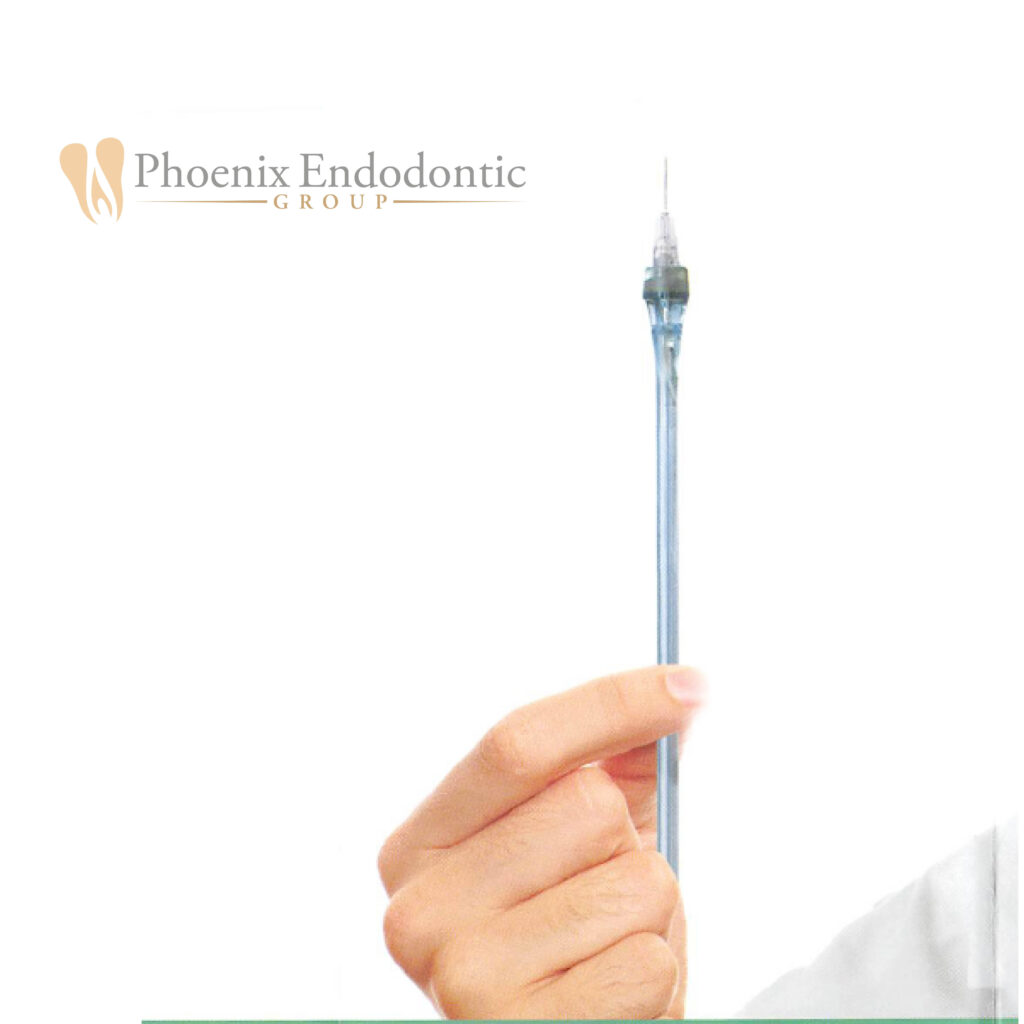
The Wand™ : A Powerful Dental Technology Breakthrough
- The Wand’s precise control allows for “single tooth anesthesia” (STA). You’re spared an entire numb mouth in favor of one numbed tooth. STA makes it easier to return to work comfortably, with no worries about talking, eating, or drinking. STA also means bilateral work on your mouth can be done on the same day.
- It doesn’t look scary. For patients with a fear of needles or of dentistry, this matters a lot. The Wand™ has a benign modern shape and is very non-threatening. The needle is a very small one in the tip of the device.
- It’s almost completely painless. This new dental technology’s precise control results in administration of the correct amount of anesthesia for the tissue, and many patients report The Wand™ makes the delivery of the anesthesia almost painless.
- It allows smile-line access. If your dentist is doing work that requires access to your smile line, this new dental technology makes it easy.
“Let us show you how our office can use new dental technology like The Wand™ to make your root canal or other procedure a more pain-free experience,” says Dr. Jacqueline S. Allen, endodontist at the Phoenix Endodontic Group. “The Wand™ makes it possible for us to give our patients a better experience with less pain and anxiety, and we’re pleased to offer it as a regular part of our practice.”
by Dr. Jacqueline S. Allen | Sep 20, 2019 | Blog, Endodontics, Endodontist, Root Canal
Millions of root canals are performed successfully each year. However, concern persists in some circles that instead of relieving a health problem – an infected or injured tooth – root canals cause illness. While there is no evidence to support this idea, rumors of the “dangers of root canal therapy” continue.
The American Association of Endodontists and other dental professionals are frequently asked by patients about the safety of root canals. Practitioners are happy to explain the root canal process and why root canals are the treatment of choice for preserving your natural teeth.
Root Canals And Health Problems: The Facts
- The primary research cited linking root canals to health problems is nearly a century old. Weston Price hypothesized in the early 1900s that bacteria trapped in a tooth treated by root canal caused diseases ranging from arthritis to heart disease. Needless to say, research methods and theories of disease causation were less advanced then; even studies conducted as early as the 1930s and 1940s indicated that there was no relationship between having a root canal and contracting a disease.
- Current research findings reinforce that root canals neither cause nor are correlated with other health challenges. In fact, a 2013 study in a publication by the American Medical Association noted that not only did root canals not cause cancer of any type, patients who had undergone multiple endodontic treatments had a 45 percent reduction in their cancer risk.
- Modern root canal treatment is safe and effective. With success rates of more than 90 percent, root canals have become reliable procedures for saving natural teeth. Digital imaging tools, advances in canal cleaning instruments, and the emergence of powerful disinfectants have all contributed to the ability of endodontists to save even seriously compromised natural teeth.
“There is a huge body of evidence demonstrating root canals are not associated with other health problems,” says Dr. Allen, who practices with the Phoenix Endodontic Group. “Your peace of mind is a top concern to us, of course, and we are happy to discuss why root canals are the best option for most people to save their natural teeth.”
