
by Dr. Jacqueline S. Allen | Mar 15, 2018 | Blog, Endodontics, General Information, Root Canal, Technology
 Endodontists are fond of emphasizing that endodontic therapies such as root canals preserve your natural teeth, allowing you to chew, speak and eat without the downsides that come with dentures or other forms of dental restorations. Most current endodontic therapy preserves the outside of a natural tooth by placing a crown over it, while replacing the failing nerve and pulp in the canals with the latex filling gutta-percha.
However, one of the most exciting developments in professional endodontics in the past generation has been research into regenerative endodontic therapy. Instead of replacing the nerve pulp with an inert substance, this groundbreaking treatment creates and delivers healthy living tissue to replace diseased, missing or traumatized pulp.
Endodontists who are at the forefront of this research combine their knowledge of pulp biology, the proper care of dental trauma, and tissue engineering to accomplish this task. The body’s own existing cells or bioactive materials are inserted in the pulp chamber to stimulate regrowth. A related procedure, apexification, employs similar methods to grow a dentin-like substance over the apex (tip) of the tooth root, in order to improve the chances of a traditional root canal treatment succeeding when the death of the pulp in a developing adult tooth has left an open apex.
Endodontic practitioners measure the success of regenerative endodontic therapy by its ability to achieve the following treatment goals:
- Elimination of symptoms
- Increased root wall thickness and/or root length
- Positive response to pulp vitality testing
While this technique is still evolving, endodontists are following the progress of its development with great interest.
“Regenerative endodontic therapy opens the door to transforming how we approach saving natural teeth,” says Dr. Allen, an endodontist in private practice with the Phoenix Endodontic Group. “It truly may lead to a clinical situation in which we facilitate the body healing itself.”

by Dr. Jacqueline S. Allen | Feb 15, 2018 | Blog, Business, Endodontist, Root Canal
 When you are trying to invest in something important – a car, say – it’s not enough to think about any type of motorized vehicle with four wheels that will get you from Point A to Point B. To get the best value for your money, you’ll have to think about how you live your life, what monthly payment you can afford, the size of your garage, and many other factors.
That same sort of individualized thinking comes into play when you have an infected or injured tooth and need to see a dental professional to fix it. You most likely will need an endodontist, a dentist who is a specialist in saving natural teeth. But there’s more to finding a good endodontist than just looking for the word in a practice’s name. Here are just a few qualities you’ll want to look for as you “comparison shop” for endodontists, to find the best specialist to work on your mouth.
Great Qualities Your Endodontist Should Have
- Specialized training. Endodontists receive two to three additional years of schooling after dental school, but because the field changes so rapidly, a commitment to continuing education is a must. Membership in an organization such as the American Association of Endodontists can indicate a practitioner is invested in remaining up to date on their education.
- A commitment to your comfort. Endodontists are experts at managing pain and discomfort, even for patients who have had challenges in this area in the past. A good endodontist will focus on your comfort level and seek to maintain or improve it throughout all procedures that are undertaken.
- Skill with current technologies. Technological breakthroughs have revolutionized root canal treatment in the past 30 years. An endodontist’s use of these tools can make your recovery from treatment quicker and help you experience less discomfort.
- A high experience level with endodontic procedures. General dentists perform, on average, two root canals per week; an endodontist may perform as many as 25. This translates into greater familiarity with different challenges and how to solve them.
- A wide network of professional colleagues. Collaborating with a network of general dentists, fellow endodontists and other dental specialists means your endodontist can accept and make referrals with ease if your case calls for one.
“As endodontists, we are committed to pursuing the education, collaboration and professional excellence it takes to properly care for our clients,” says Dr. Jacqueline S. Allen, a partner with the Phoenix Endodontic Group.

by Dr. Jacqueline S. Allen | Dec 13, 2017 | Blog, Cracked Teeth, Endodontist
While many of us appreciate the change in schedule that the winter holidays usher in, if we experience a dental emergency during a holiday, it can be difficult to determine what conditions require immediate care by a dentist and which don’t. Here are a few guidelines to help you determine whether your dental pains are serious or not, and what to do next.
 Red Alert: Don’t Ignore A Dental Emergency
If you experience a dental injury that is the result of a blow to the head or face, involves a laceration, serious cut, a jaw fracture or dislocation, or is caused by an infection in your mouth so severe it’s impacting your ability to breathe or swallow, you’ll want to head directly for the ER. All of these conditions are potentially life-threatening and need immediate medical attention.
Yellow Alert: Urgent But Not Emergency Conditions
There is another category of dental crisis that normally necessitates a next-day trip to the dentist. Some of these conditions include:
- Cracked or broken teeth
- A knocked-out tooth that was not the result of face/head trauma
- A dental abscess that’s painful but not interfering with breathing or swallowing
If your dentist or endodontist is not available due to a holiday closure, call the office’s emergency number. The practice may have a designated emergency provider, or your provider may be able to call in an antibiotic to eliminate infection.
Green Alert: Situations Where Home Care Can Work
Although it may make for a challenging day or two, some dental conditions can be managed from home until the dentist is open for business after the holidays.
- If you lose a filling, your pharmacy may carry temporary dental filling material to protect your tooth.
- A mild toothache may respond to over-the-counter pain relievers until the dentist visit can be scheduled.
- Some minor dental discomfort can be relieved by chewing on the side opposite the painful tooth until your appointment.
- Keep the affected area of your mouth clean by swishing with salt water.
“Our practice makes every effort to see clients the same day that they call,” says Dr. Jacqueline S. Allen, a partner at the Phoenix Endodontic Group. “We see patients on an emergency basis 24 hours a day, seven days a week. However, when there is a delay before a client can see the dentist, we can help them determine the safest and most comfortable way to make it through a holiday.”

by Dr. Jacqueline S. Allen | Nov 13, 2017 | Blog, Endodontics, Endodontist, General Information, Root Canal
 Like most health-enhancing procedures, the technologies and techniques used to provide root canals have been steadily advancing, especially over the past few decades. Today’s root canal procedure is considerably easier on patients than it was in the 1980s, or even the 1990s.
Something that may surprise you, however, is that root canals have been around for well over a century. Here’s a brief list of historical milestones related to root canal procedures, to foster appreciation for how they have developed.
Important Dates In Root Canal History
- 1728 – Pierre Fauchard, a French physician regarded as the father of modern dentistry, authors the book “Le chirurgien dentiste,” which describes the existence of dental pulp.
- 1838 – American Edwin Maynard creates the first root canal instrument, which he fashions from a watch spring.
- 1847 – Gutta-percha is introduced as a material for filling dental canals.
- 1890s – Crowns are becoming increasingly popular as a dental restoration. Many require canal posts, which increases interest in endodontic treatments such as root canals.
- 1900 – The emerging imaging technology of X-rays is identified as an important tool for diagnosing tooth root problems.
- 1943 – The American Association of Endodontics is established to facilitate professional practice in this specialty.
- 1950s – After a half-century of controversy, research establishes that natural teeth needing root canals do not cause systemic health problems, leading to a renewed interest in endodontics.
- 1990s to the present – Endodontic root canal treatments receive an upgrade due to improved imaging techniques, the advent of rotary nickel-titanium files to clean canals, and use of new irrigating solutions.
“Root canals have never been a static procedure, with only ‘one right way’ to preserve a challenged natural tooth,” says Dr. Allen of the Phoenix Endodontic Group. “Endodontists in all eras have striven to improve the experience for patients and create successful outcomes.”

by Dr. Jacqueline S. Allen | Oct 18, 2017 | Blog, Endodontics, Phoenix Endodontic Group, Root Canal
The last several weeks in October seem to be high season for those who love all things scary, including horror movies, gory Halloween costumes and the like. But very few people seem to use the season to embrace their fears of real-world situations. If the prospect of getting a root canal has you quaking in your boots more than a trip to the store to buy your Halloween costume, let’s address several common fears about them, so you can take that dental procedure out of your personal mental category of “spooky.”
Getting Over Your Fear Of Root Canals
Fear #1: My root canal treatment will be painful.
Fact: The tools and techniques that endodontists currently use to work with patients minimize pain and maximize the chances that he or she will be able to save your natural tooth. The discomfort you might experience during a root canal is similar to what you might experience if you were having a tooth filled. For many patients, a root canal actually relieves the pain they’ve been experiencing due to an injured or infected tooth.
Fear #2: My root canal treatment will involve frightening procedures or loud noises.
Fact: One fear common to many types of dental anxiety is undergoing a treatment involving complex, unfamiliar activities or which involves loud noises. Your endodontist can explain how he or she will perform the root canal, and is able to offer an array of remedies to keep you calm and comfortable during the procedure.
Fear #3: My root canal treatment won’t last, so why bother?
Fact: Some patients hesitate to get a root canal based on the faulty belief that they’re rarely successful, and wonder if they should just move directly to getting the tooth extracted. The data on root canals show that they preserve the natural tooth 95 percent of the time, so it is definitely a procedure worth considering!
“There are a lot of situations in life that require caution and heeding one’s fears, but root canals simply aren’t one of them,” says Dr. Jacqueline S. Allen, who practices with the Phoenix Endodontic Group. “Your endodontist can help you overcome your fears related to this important dental procedure.”
by Dr. Jacqueline S. Allen | Oct 12, 2017 | Blog, Endodontics, Phoenix Endodontic Group

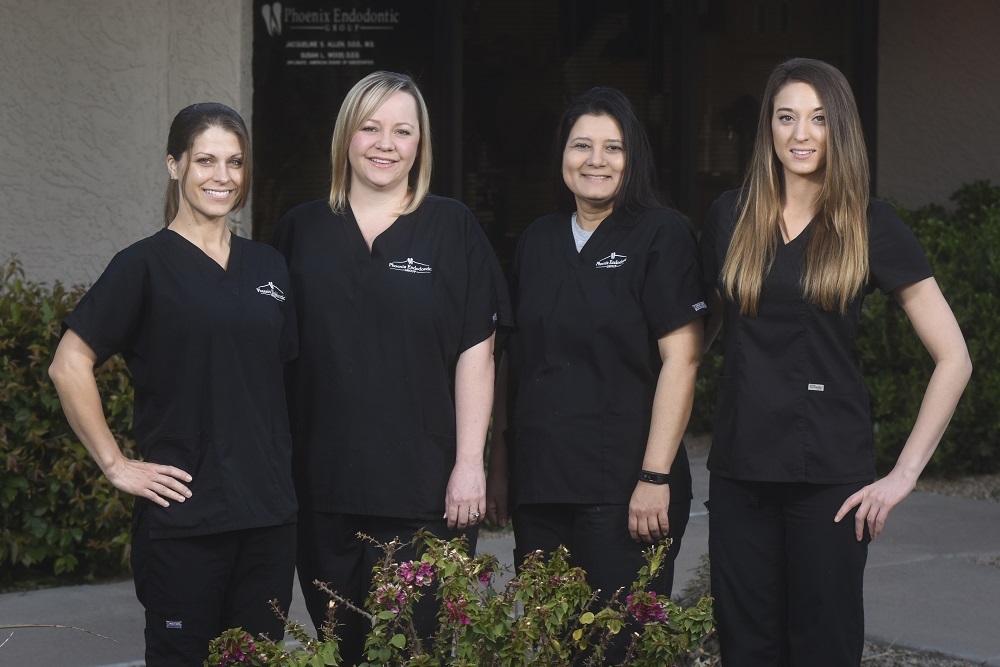
Suzie Salas, second from the right.
As part of our Employee Spotlight series, this month we are featuring our amazing dental assistant, Suzanna Salas. At Phoenix Endodontic Group, Suzie offers extensive dental knowledge and proves herself to be a key asset to our team. Suzie provides exclusive tips and unique insight regarding Phoenix Endodontic Group.
1.) What is something that makes Phoenix Endo unique?
Phoenix Endodontic Group is involved in the community and multiple charity events to help others in need. Our team goes above and beyond to give back to the community and help dental patients in need with their pain.
2.) What would you say is your dental philosophy?
My dental philosophy is to give each dental patient the best care in a friendly and pain-free environment.
3.) What made you go into the endodontics field?
I find all aspects of specialty dentistry and oral surgery to be extremely intriguing. Not only this, my passion for helping others is fulfilled knowing that patients are leaving happier and healthier than they did when they came to our office initially. I enjoy continually educating myself on different dental techniques and Phoenix Endodontic Group provides me with the resources to grow tremendously in my profession!
4.) Where do you see Phoenix Endodontic Group going in the next five years?
In the next five years, I believe Phoenix Endodontic Group will grow in the endodontic community and looked to as a leader in the dental industry.
5.) Why do you volunteer at AZMOM?
I am extremely passionate about volunteering at AZMOM because there are many people who are unable to afford dental treatment and I can use my expertise to give them the dental care they need.
6.) How do your bilingual skills play a part in your day-to-day operations?
Being bilingual helps service patients who may not be proficient in English. Speaking Spanish allows our business to grow in different areas and become more marketable among the dental community.
7.) Describe Phoenix Endo in three words.
It is difficult to describe our office in only three words! We are highly diverse and unique in different ways. The top three words to define Phoenix Endodontic Group are friendly, caring and available.
8.) What is the number one oral health mistake every patient makes?
Oral health is vital to our overall health so it is extremely important to know proper dental care techniques. Many patients do not brush or flossing properly and thus ignore bleeding gums. If you are suffering from bleeding gums, it is of utmost importance to make an appointment with Phoenix Endodontic Group to receive proper care.
9) What piece of advice can you offer all patients?
The best advice I can offer our patients is combined in two parts. Firstly, it is vital to follow proper oral hygiene. Secondly, see your dentist on a regular basis. These two components will prevent tooth complications and costly dental work.
Our team will restore your smile and heal you of pain. To learn more about our practice, or to schedule an appointment, call (602) 748-4190, or visit our website.
